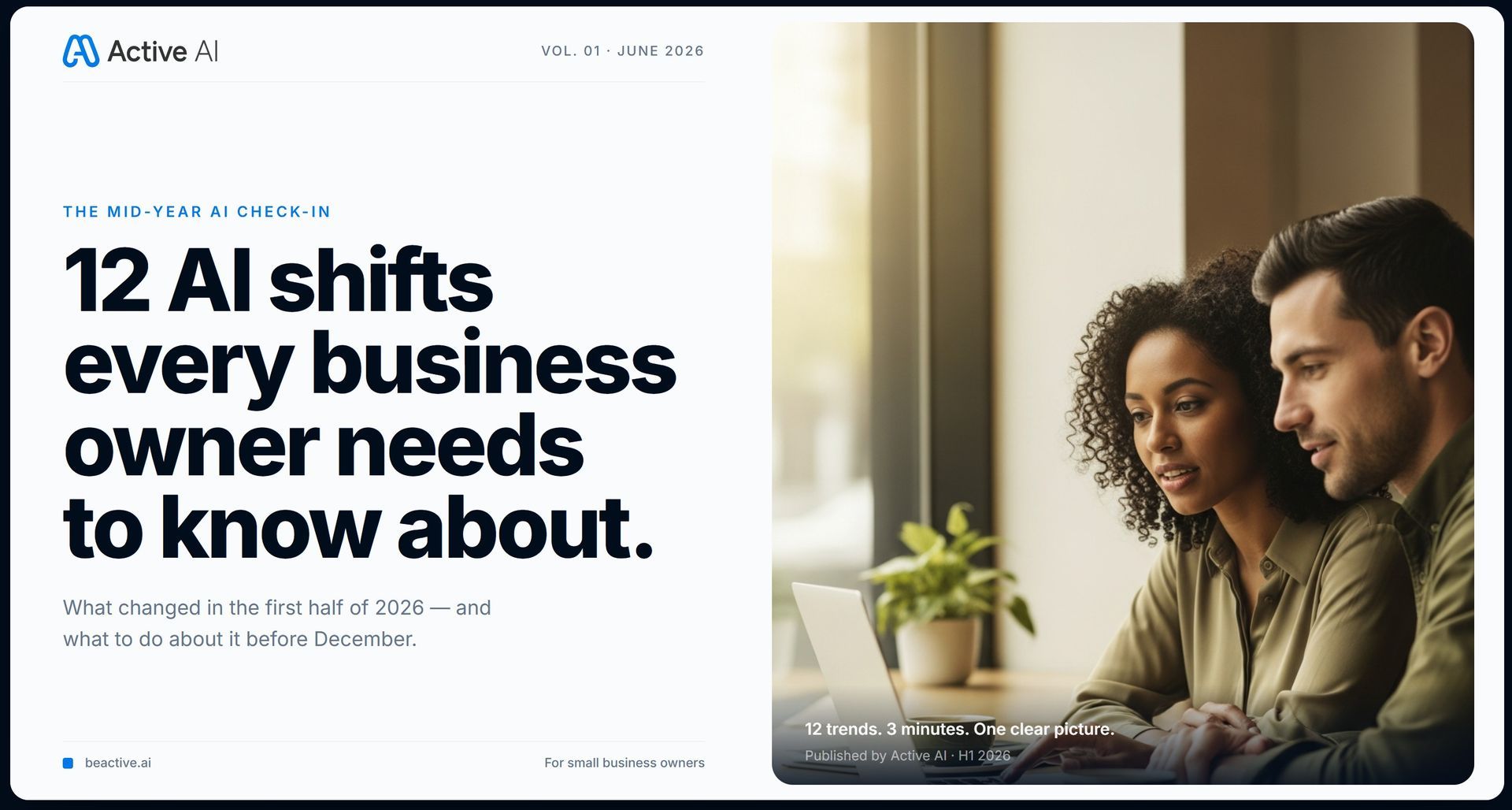
2026 AI Mid-Year Report
12 AI Shifts Every Business Owner Needs to Know About in 2026
Artificial intelligence is no longer a future trend. It is already changing how businesses operate, sell, support customers, create content, build software, train teams, and make decisions.
The biggest mistake business owners can make right now is assuming AI is still just a tool for writing emails or creating social media posts. That version of AI was only the beginning.
In 2026, AI is moving from experimentation into real business operations.
At Active AI, we help businesses build custom software, AI-powered applications, automation tools, internal AI assistants, and technology solutions designed around their real workflows. We work with companies that want to save time, improve operations, build better customer experiences, and turn AI ideas into real products.
That is why we created our new free report:
12 AI Shifts Every Business Owner Needs to Know About
What changed in the first half of 2026 — and what to do about it before December.
There is no sign-in required, no form, and no email gate. You can simply open it and read it.
Read the free report here:
https://2026midyearreport.beactive.ai/
What changed in 2026?
The short answer: AI became more practical.
For the last few years, most business owners were trying to understand what AI could do. They tested ChatGPT, asked it to write content, summarized a few documents, or explored different tools.
But in 2026, the conversation changed.
AI is no longer just something you use occasionally. It is becoming part of the infrastructure of modern businesses. It can help companies answer questions, manage knowledge, automate tasks, build software, create video, support customers, and coordinate work across teams.
Here are the 12 biggest AI shifts every business owner should understand.
1. Reasoning models went mainstream
Early AI models were impressive, but they often felt limited. They could answer questions, write content, and summarize information, but they were not always strong at deeper thinking.
Reasoning models changed that.
These newer AI models are better at working through complex problems, comparing options, planning steps, and helping with decisions. For a business owner, this matters because AI is no longer just useful for simple tasks. It can now support more strategic work.
You can use reasoning models to think through a business plan, review a proposal, analyze customer feedback, plan a software build, compare vendors, or identify weak points in an operation.
The value is not that AI replaces your judgment. The value is that it becomes a thinking partner that helps you move faster and see more clearly.
2. Memory windows hit 10 million tokens
One of the biggest technical changes is that AI models can now handle much larger amounts of information at once.
In simple terms, AI can “read” and work with far more context than before. Instead of giving it a short prompt or a small document, businesses can now feed AI large files, long conversations, policy manuals, product documentation, operational procedures, client histories, and more.
This matters because business knowledge is usually scattered everywhere.
It lives in PDFs, emails, spreadsheets, Google Drive folders, training documents, old proposals, websites, CRMs, Slack messages, and inside people’s heads.
Larger memory windows make it easier to build AI systems that understand more of your company’s real information.
That opens the door to better internal assistants, smarter customer support, faster onboarding, and stronger decision-making.
3. AI agents now use your computer
AI agents are one of the biggest shifts in 2026.
A chatbot answers questions. An AI agent can take action.
This means AI can help complete multi-step tasks using software, websites, documents, databases, browsers, and internal tools. For example, an AI agent could help collect information, update a CRM, draft a proposal, create a report, send a follow-up, or organize files.
For business owners, this is where AI starts becoming operational.
The goal is not to give AI unlimited control. The goal is to design clear, safe workflows where AI can handle repetitive steps and humans remain in control of important decisions.
Companies that understand AI agents early will have a major advantage.
4. Frontier AI now costs less than your phone bill
A few years ago, the most powerful AI systems felt expensive and inaccessible. Today, access to highly capable AI is surprisingly affordable.
This changes the economics of business technology.
Small and mid-sized companies can now use tools that would have felt impossible just a few years ago. They can build AI-powered apps, internal assistants, automation systems, client portals, and custom tools without needing enterprise-level budgets.
This does not mean every project is cheap or simple. Good strategy, development, testing, security, and implementation still matter.
But the cost barrier has dropped dramatically.
The businesses that take advantage of this shift can move faster than competitors still waiting for AI to become “ready.”
5. Open-source AI caught up to closed models
Another major shift is the rise of open-source AI.
Closed models from major AI companies are still powerful, but open-source models have improved quickly. This gives businesses more flexibility.
Open-source AI can be useful when companies want more control, customization, privacy options, or specialized deployments. For some projects, a closed model is still the best choice. For others, open-source may offer a smarter path.
The important point is that business owners now have more options.
AI strategy is no longer just about choosing one tool. It is about choosing the right model, setup, and workflow for the business problem you are trying to solve.
6. Humanoid robots entered real factories
Humanoid robots are no longer just science fiction or demo videos. They are starting to appear in real industrial environments.
For most small businesses, this does not mean a humanoid robot is showing up tomorrow morning. But it does show where the market is going.
Physical AI is becoming real.
Robots are beginning to combine movement, vision, reasoning, and task execution in ways that could eventually affect warehousing, manufacturing, logistics, construction, healthcare, retail, and service businesses.
Business owners should not panic, but they should pay attention.
Robotics may create new opportunities for efficiency, labour support, safety, and service delivery over the next few years.
7. AI video became production-grade
AI video has improved dramatically.
What used to look strange or experimental is quickly becoming usable for real marketing, training, education, product demos, social media, and internal communications.
This is a big deal for businesses.
Video is one of the most powerful communication formats, but it has traditionally been expensive and time-consuming. AI video tools now make it easier to create visual content at scale.
Companies can create training videos, explainer videos, product walkthroughs, ad variations, personalized sales content, internal updates, and more.
The businesses that learn how to use AI video well will be able to communicate faster and produce more content without needing a full production team for every asset.
8. Voice agents replaced the front desk
Voice AI is becoming one of the most practical applications for local businesses and service companies.
AI voice agents can answer calls, qualify leads, book appointments, answer common questions, route requests, and collect important information.
This is not just about replacing a receptionist. It is about making sure fewer opportunities are missed.
Many businesses lose leads because they miss calls, respond too slowly, or do not follow up properly. A voice agent can help provide coverage, consistency, and speed.
For clinics, service companies, contractors, agencies, dealerships, real estate businesses, and professional services, this can become a major operational advantage.
9. Custom software stopped being only a developer thing
This is one of the biggest opportunities for business owners.
Custom software used to feel intimidating. You needed a large budget, a long development timeline, and a technical team to even get started.
Now, AI-assisted development makes it possible to move from idea to working prototype much faster.
This does not mean every business owner should build software alone. Strategy, UX, security, architecture, and implementation still matter. But the distance between an idea and a real product has become much shorter.
Companies can now build internal dashboards, client portals, AI tools, workflow platforms, niche SaaS products, quote generators, reporting systems, booking tools, and custom apps faster than before.
If you have a process that is currently being managed manually through spreadsheets, emails, and disconnected tools, custom software may now be more accessible than you think.
10. Customers now shop through AI agents
Customer behaviour is changing.
People are starting to use AI agents to research products, compare options, summarize reviews, ask for recommendations, and make decisions.
This has major implications for marketing.
In the past, companies focused heavily on ranking in Google and creating content for human readers. That still matters. But now businesses also need to think about how AI systems understand, summarize, and recommend them.
Your website, content, reviews, FAQs, product information, service pages, and online reputation all become part of what AI agents may use to evaluate your business.
The companies with clear positioning, helpful content, strong credibility, and structured information will be easier for AI systems to understand and recommend.
11. Solo bots gave way to coordinated AI teams
The next stage of AI is not just one assistant doing one task.
It is coordinated AI teams.
This means different AI agents can work together on different parts of a process. One agent might research. Another might summarize. Another might write. Another might review. Another might prepare a report. Another might update a system.
For businesses, this creates a powerful idea: AI can support entire workflows, not just isolated tasks.
Imagine a sales workflow where AI researches a prospect, prepares a personalized email, updates the CRM, drafts a proposal, reminds the salesperson to follow up, and summarizes the call notes.
That is much more valuable than a single chatbot.
12. Your competitors already moved
This may be the most important shift.
Many companies are no longer asking whether AI matters. They are already testing tools, building systems, automating workflows, training teams, and exploring custom software.
The danger is not that AI will suddenly destroy your business overnight.
The danger is that competitors become faster, more efficient, more responsive, and more organized while you stay the same.
They may answer leads faster.
They may create content faster.
They may support clients better.
They may reduce admin work.
They may build internal tools.
They may launch new digital products.
They may use data more effectively.
Over time, that advantage compounds.
What should business owners do before December?
You do not need to transform your entire company overnight.
The smartest approach is to start with practical opportunities.
Look at your business and ask:
Where are we losing time?
Where are we repeating manual work?
Where are customers waiting too long?
Where are employees asking the same questions?
Where is information hard to find?
Where could software improve the process?
Where could AI help us deliver a better experience?
From there, choose one or two high-impact projects.
That could be an internal AI assistant, a voice agent, a custom dashboard, a client portal, a workflow automation, an AI-powered app, or a better lead follow-up system.
The key is to stop thinking about AI as a generic tool and start thinking about it as a business design opportunity.
Read the full free report
We created 12 AI Shifts Every Business Owner Needs to Know About to give business owners a clear, practical overview of what changed in 2026 and what they should start thinking about now.
There is no sign-in required. No form. No email gate.
You can read it here:
https://2026midyearreport.beactive.ai/
Ready to build something with AI?
At Active AI, we help businesses turn AI ideas into real technology.
Whether you need a custom app, an internal AI assistant, workflow automation, a client portal, a voice agent, or a full AI-powered software platform, we can help you design and build something that actually works for your business.
Start Now with Your Free Consultation:
https://www.beactive.ai/book-a-free-consultation-active-ai